


Beyond the Switch: Designing Light as an Experience
Turning on the light is, in all likelihood, the most repeated and least questioned domestic gesture in the world. An automatism we take for granted—yet behind that switch, or the increasingly common voice command, lies an invisible universe of design. Today, designing light no longer simply means “illuminating a space”: it means managing a complex system of experiences, emotions, and biology.
The lighting designer’s work begins in darkness, not with the lamp
For a lighting designer, the process never starts with choosing a light source, but with its opposite: analyzing darkness and shadows. Before the light turns on, there is a phase of “spatial choreography,” where materials, reflections, and daylight factors are studied. Fundamental at this stage is the dialogue with the client—the person who will actually inhabit the space. As we will see, light must adapt to them: this is the starting point of every good design. From this exchange arise diverse and articulated needs that go far beyond switching on a single source: how many lights and how many switches are needed to avoid the classic “treasure hunt” in the dark to find the right one?

Lighting scenarios: designing perception like a director
Another fundamental step in lighting design is placing light in the right position. Turning on a light also means conveying a message: light communicates, it transmits a feeling or a state of mind. Every room, every living space has its own light, allowing us to experience different moments of the day in the best possible way. Whether it is the kitchen where meals are prepared, the living room where one reads in the evening, or an outdoor space with a pool, light takes center stage—and must do so at its best.
Once all the necessary information has been gathered, the lighting designer must orchestrate these sensations through lighting scenarios. Designing a lighting scenario means acting as a director of perception, transforming inhabited space into a sequence of lived experiences. It is not simply about placing luminaires, but about orchestrating a visual program capable of evolving with time and function.
To translate an emotional intention into an effective control system, the lighting designer must master precise technical variables: from correlated color temperature (CCT), which defines the psychological tone of the environment, to color rendering (CRI), essential for the true appearance of materials. Equally crucial is optical control, which allows spatial hierarchy through calibrated contrasts, avoiding glare and ensuring visual comfort.
In particular, color temperature is a key element when discussing psychophysical well-being. Think of sunlight: throughout the day, from morning to evening, its color changes and influences our body rhythms. In the morning it energizes us; in the evening it prepares us for rest. This function must be recreated: cooler light to maintain alertness—in the kitchen, dining room, or study—and warmer light for evening reading on the sofa or for conversations with guests.
Technique and emotion: the boundary is an illusion
Where does the boundary lie between engineering precision and poetic sensitivity? In reality, this boundary is a perspective illusion. Technique is not the opposite of emotion, but its only reliable vehicle. Without the rigor of lighting calculations, “poetry” would remain a vague intention—or worse, a functional error. True sensitivity lies in knowing exactly which physical parameter to adjust to evoke a memory or an atmosphere, making technology invisible so that only the narrative of the space emerges.
Smart control: why a switch is no longer enough
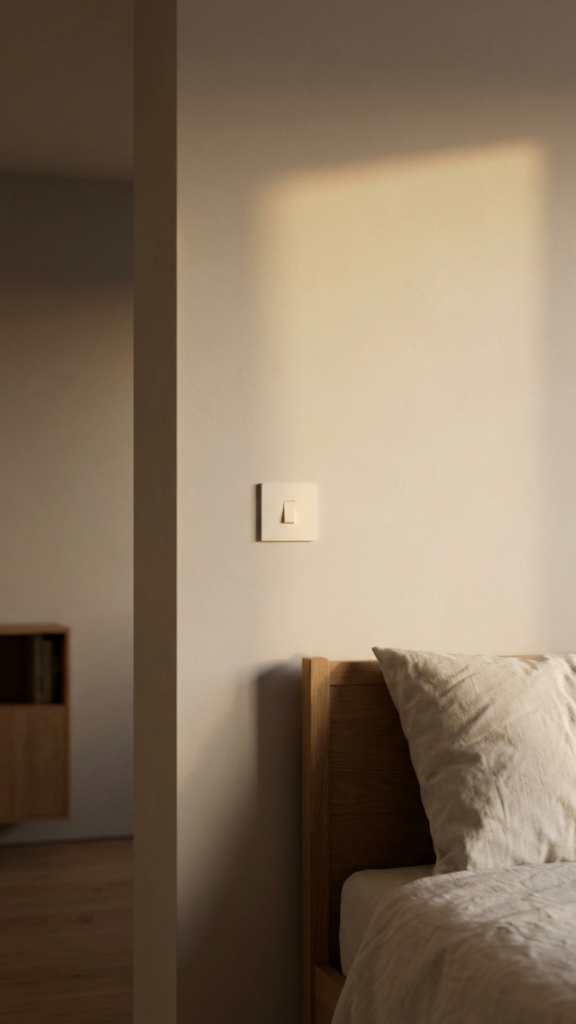
If the lighting designer must orchestrate all this, why settle for a simple switch? Today, it is more appropriate to speak not of switching lights on, but of real scenarios that the client can recall through buttons and sensors installed in the environment.
In this context, many tools now exist to control light and make it “intelligent.” Control can be achieved in various ways, but perhaps the most important and suitable lies in the use of home automation. With the right use of sensors and controls, many of the automatic functions described become feasible. Professionals in this field must now deal not only with lighting itself, but with the ability to manage luminaires both technically and in terms of control. Reflecting on the advantages of a smart system is no longer optional—it is an integral part of the project.

Energy savings and value: the investment the client does not yet see
All this technology has a cost for the client, but what is being built is not an expense—it is a resource optimization strategy. When we talk about the “electricity bill,” savings no longer come only from replacing old bulbs with LEDs, but from the ability to manage light intelligently and precisely. An advanced control system transforms lighting from a passive cost into a dynamic asset. The data is clear: integrating presence sensors, automatic adjustment based on natural light (daylight harvesting), and dimmable scenarios can reduce a residence’s electricity consumption by up to 50%.
Yet bill savings, as concrete as they are, appeal to long-term rationality. To convince a client today, this technical advantage must be translated into immediate and tangible terms. “Savings” must be redefined as value and personal comfort: the longevity of LED sources used steadily at 70% of their capacity, the flexibility of spaces that can change function without structural work, and the quality of time spent at home without visual fatigue.
The client must perceive that they are not paying to “have more light,” but to have total control over their comfort. The advantage is not only economic—it is the freedom not to waste. Light becomes like a tailored garment that adapts to the movements of the wearer, eliminating every unnecessary excess. Even before the bill, the client will evaluate it through the fluidity of everyday living.
Human Centric Lighting: the invisible well-being the industry can no longer ignore
The relationship between artificial light and health is one of the most fascinating frontiers of modern science, yet in the residential sector the topic of lighting well-being often remains confined to a deafening silence. Although research has shown how light regulates our circadian rhythms, metabolism, and sleep quality, this awareness struggles to translate into explicit demand from clients. The reason is mainly cultural: light is still perceived as a functional or aesthetic element. We are used to “buying lamps” rather than “living in light.” Well-being is invisible, and its effects are cumulative: poor lighting does not cause immediate damage like a leaking roof, but silently wears down our biology, influencing cortisol and melatonin levels. Investing in Human Centric Lighting is still seen by many as a luxury, whose benefits appear less tangible than the beauty of a design piece.
In this scenario, the designer must become an educator. Their role is not to passively satisfy the client’s tastes, but to reveal the invisible: to explain that overly cold and intense light in the evening is a “pollutant” for the brain, while light that follows the natural cycle of the sun is true preventive medicine. Changing perception means shifting the project’s focus from the object to the person: only when the client understands that light is not just for seeing, but for feeling well, will lighting well-being finally become a fundamental priority.

The designer of the future: a technological humanist
Those working in this field today have far more responsibilities than in the past—and far more tools to meet them. We have the duty to communicate the benefits of well-managed light and to warn those who still think they are dealing with a simple light bulb.
Today we are in the era of home automation. But in the not-so-distant future, we will face artificial intelligence systems capable of further improving the management of light in everyday life. The greatest challenge, however, will remain cultural. The designer of the future must be a technological humanist: navigating neuroscience to understand the impact of light on the psyche, and environmental sustainability. The true intelligence of a project lies not in the complexity of the control unit, but in its ability to become invisible. Those who can combine the rigor of bits with sensitivity to biological well-being will be the ones who shape the light of tomorrow: an intelligence no longer merely artificial, but deeply empathetic.
“Power is nothing without control.” This applies to light as to everything else.
Text by:
Giovanni Launaro
Lighting Designer, System Integrator, AILD member


