


Light That Reveals Materiality
How LED lighting enhances historic materials without erasing their identity
By the LED Italy Editorial Team
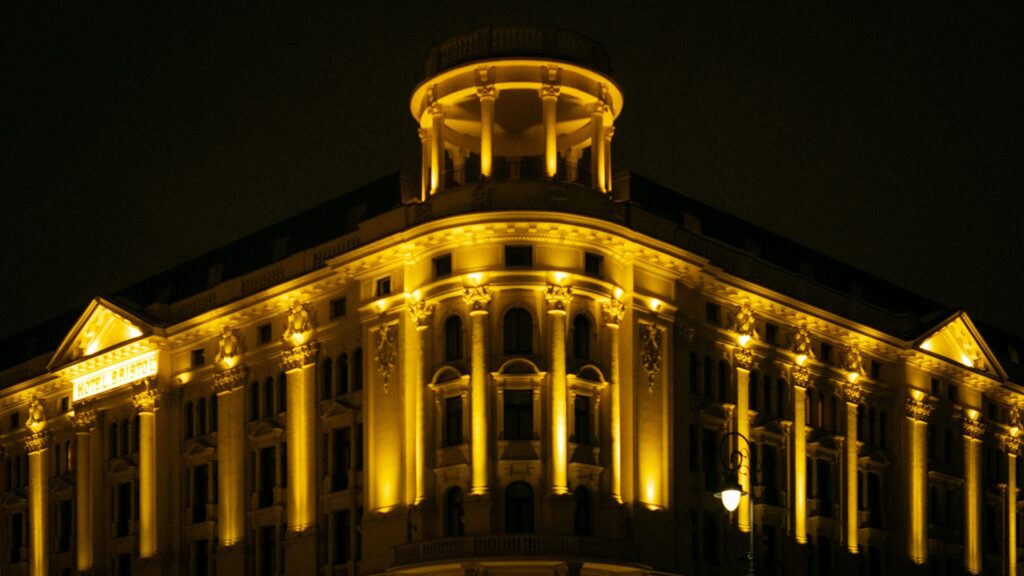
In lighting design, there is a quiet paradox that plays out every day in many of the most beautiful spaces we have inherited: the light intended to enhance them actually flattens them.
Stone loses its depth. Aged wood becomes an ordinary surface. Wrought iron is reduced to a flat silhouette, stripped of the three-dimensional quality that once made it so extraordinary under candlelight or the glow of a gas wall lamp.
This is not a question of budget, nor of the quality of the installed materials. Rather, it is a matter of method — and awareness.
In its most widespread and least considered applications, LED light is emitted uniformly, frontally and indiscriminately. It illuminates everything in the same way. Yet when working with surfaces that carry their own history, texture and layers of time, illuminating everything equally is equivalent to erasing their character.

When light meets the surface
Every material responds to light differently. It does not merely receive it: it absorbs it, reflects it, breaks it apart and returns it to the surrounding space. This is where lighting design ceases to be a purely technical discipline and becomes an interpretation of materiality.
Natural stone, for example, depends on subtle shadows. Uniform frontal lighting can make it appear flat, while grazing light reveals its porosity, cuts, veins and irregularities.
Wrought iron, by contrast, produces sharper, more specular reflections. It multiplies the light source, creates points of intensity and requires careful control to prevent those highlights from becoming glare.
Aged wood needs light that follows the direction of its grain rather than overpowering it. Decorative plasterwork requires balance: enough contrast to reveal its relief, yet enough softness to avoid exaggerating it.
This is the principle of reverberation, understood not only as a physical phenomenon but also as a form of perceptual memory: light carries something of the material it encounters. When the surface is historic, light must also learn how to engage with time.

The lesson of the masters: lighting does not mean revealing everything
The great designers have always understood this. Carlo Scarpa, more than most, developed a radical approach to the relationship between light, detail and material.
In his projects, light is never generic. It arrives from a precise point, at a precise angle, to reveal a texture, a joint, a craftsmanship detail or a variation in the surface.
This sensitivity is not limited to museum architecture. Historic European hospitality interiors have also frequently used light as a means of control. Lampshades, wall lights, shielded sources and indirect reflections were not intended merely to create atmosphere, but also to regulate how light fell upon decorated surfaces.
Lighting a historic hotel today means continuing this line of thought using contemporary tools. The aim is not to imitate the light of the past, but to respect its intelligence: light that accompanies the space rather than overwriting it.
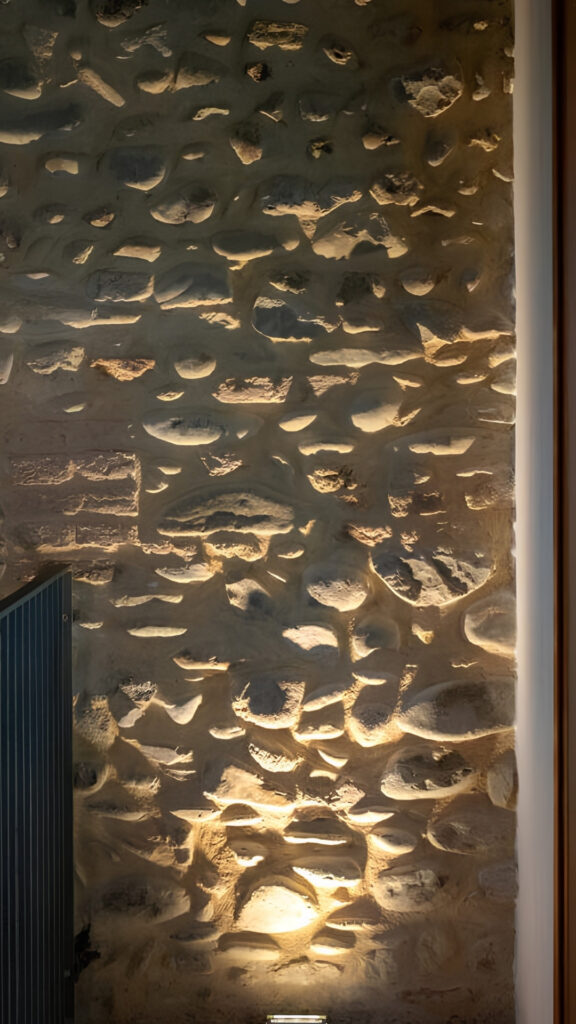

Contemporary LED technology and historic materials
LED technology now offers possibilities that, until only a few years ago, were difficult to achieve with the same degree of precision.
Flexible LED strips, linear profiles, controlled optics, calibrated colour temperatures, individual dimming and high colour rendering make it possible to create complex lighting scenarios, even in sensitive settings such as historic hospitality venues, listed buildings, boutique hotels, museums and prestigious institutional spaces.
The objective is not to “add light”, but to choose the right light.
An LED strip can become a blade of grazing light running along wood panelling, an indirect presence that gives visual lightness to a decorated ceiling, a concealed line that guides the eye along a stone staircase, or a carefully measured accent on a wrought-iron detail.
The flexibility of the system becomes valuable only when it is guided by a clear design vision.
In this sense, the product is never the absolute protagonist. It is the instrument that allows the material to become readable once again. Good lighting does not announce itself: it brings out what the place already possesses.

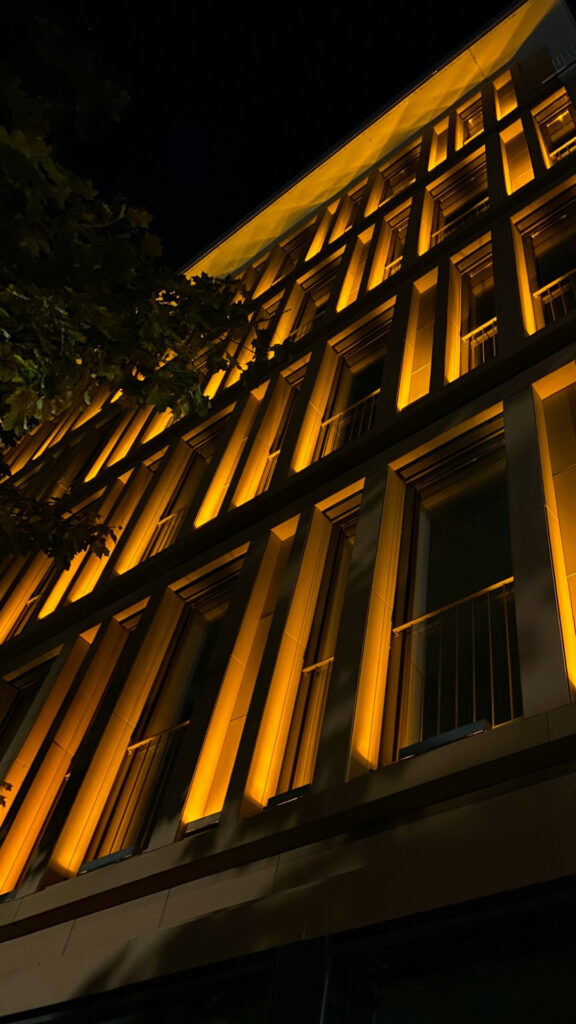
Expertise before technology
Lighting for historic architecture carries a particular responsibility. Knowing about lumens, watts, CRI, colour temperature and protection ratings is not enough.
A broader form of expertise is required: one capable of understanding the behaviour of materials, the proportions of a space, its architectural memory and the perceptual experience of those who move through it.
This is where the role of architects and lighting designers becomes decisive. Contemporary LED technology provides increasingly precise tools, but it cannot decide on its own where the light should fall, how far it should be recessed, when it should be softened or when it should allow shadow to remain.
Ultimately, lighting is never simply a matter of tools, but of vision.
The ability to enhance historic architecture emerges from a conscious synthesis of technical expertise, historical sensitivity and careful observation. Only through this approach can light fulfil its highest purpose: revealing materiality without ever overpowering it.


